
Our classes

Nursery Groups

From the first smile to the first steps, each milestone in a child’s life is a testament to their growth and development.

Understanding these stages helps parents and educators support the child’s learning and emotional needs effectively. Here’s a breakdown of the key stages in early childhood development:

01

Cocoons (under twos)

Providing a high-level of care and nurturing for our youngest children.

The room is cosy, restful and neutral and is adjacent to the nappy changing area, it also includes a dedicated milk kitchen to make up feeds.

We have a range of equipment & resources to care for our youngest babies right up to toddlers.

Based on their first floor we often take our babies to their own area of the garden as well as taking them out for walks in the pushchairs to see and explore our local community.

Physical
Rolling over, sitting up, crawling, and eventually walking.
Cognitive
Recognising faces, responding to their names, and exploring touch.
Emotional
Forming strong emotional bonds with caregivers, expressing feelings.
02

Caterpillars (twos)

More mobile than our babies but still needing a high-level of care as they gradually explore larger spaces of the nursery.

With access to the garden, soft play room and their own Sleep Room they are free to explore both indoor and outdoor play areas.

We operate on a ratio of 1 adult to 4 children as we feel that our two year olds still need a high-level of care.

Adjacent to their own toilets allows our two year olds to easily begin toilet training.

Physical
Running, jumping, and fine motor skills like holding a crayon.
Cognitive
Understanding cause and effect, beginning of ‘pretend play’.
Emotional
Playing alongside peers, showing affection, and beginning to share.
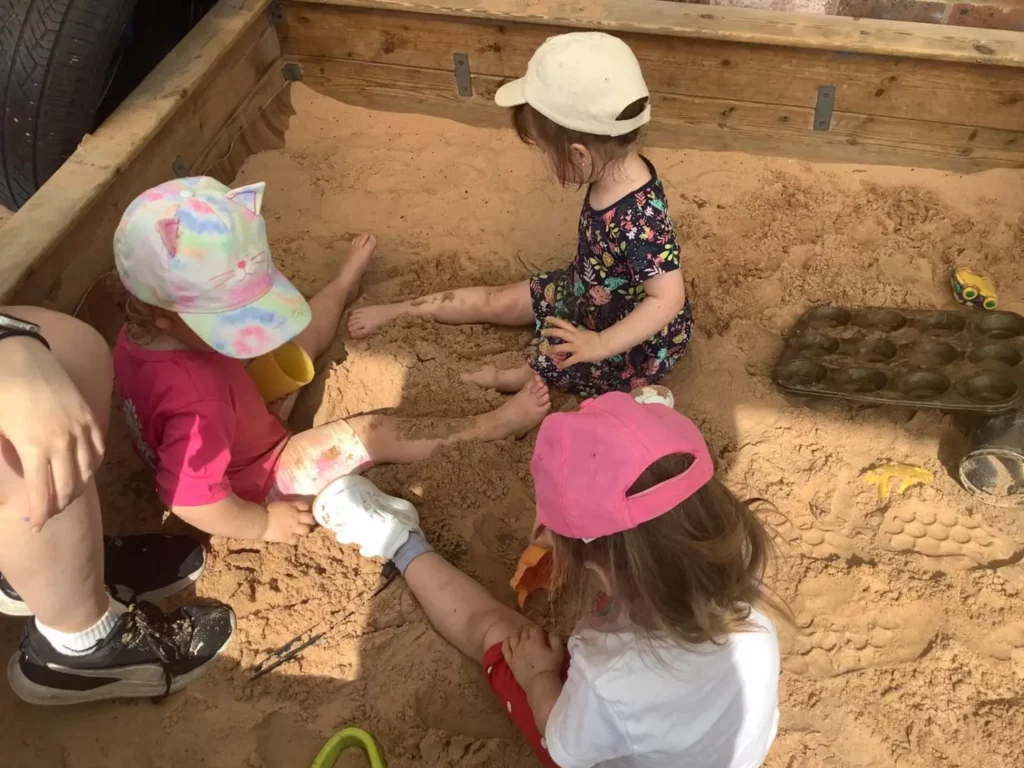
Children playing in a sandpit
03

Grasshoppers (threes)

Increasing in confidence & independence, our three year olds have their own dedicated space to play and explore.

We still provide the high-level of adult support that they need and work to a ratio of 1 adult to 6 children.

Our three year olds continue to free-flow with the garden area and often get to play in the courtyard on the bikes and scooters which they love to do!

Physical
Improved coordination and ability to handle complex tasks.
Cognitive
Recognising patterns, starting to count, and understanding concepts.
Emotional
Developing friendships, learning compromise, and recognising feelings.
04

Butterflies (pre-school)

Our older children occupy the ground floor of the building and get used to moving around a building as they would at school.

They become confident at climbing the stairs and our first floor also has its own children’s toilets and kitchen facilities.

Our pre-school children still learn through play but have a slightly more structured day.

We continue to use the garden and courtyard and are often riding the bikes, gardening and playing games.

Physical
Writing their names, playing sports, doing complex tasks in school.
Cognitive
Reading simple books, understanding mathematical concepts.
Emotional
Respecting rules, showing empathy, developing self-awareness.

Our facilities

An illustration of some building blocks

Sensory and soft play rooms

Calming sensory space plus padded environment for active physical development.

An illustration of a paint palette

Creative arts space

Dedicated areas for art, craft and messy creative activities that inspire imagination skills.

An illustration of a calculator

Literacy and role play

Book corner and imaginative play areas for learning through play and hands on activities.

An illustration of some fruit

Garden and courtyard

Outdoor spaces for nature exploration, gardening, bikes and scooters.

An illustration of a bowl with food in it

Nutrition spaces

Milk kitchen for infant feeds and children's kitchen for food activities.

An illustration of a bed

Sleep and care facilities

Rest rooms, nappy changing area and children's toilets across both floors.

Illustration of a bee

Frequently asked questions

Ask a question

Children move between groups based on their age, development and readiness, rather than a fixed date.
We work closely with parents to ensure transitions feel gradual, familiar and supportive for each child.

Where possible, we aim to maintain familiar faces to help children feel secure.
Strong relationships with trusted adults help children settle quickly and build confidence in new environments.

Each room is designed to support children’s physical, cognitive and emotional development at that stage.
Activities, routines and resources are carefully adapted so children are challenged while still feeling comfortable and supported.

Ratios vary depending on the age group, following best practice for each stage of development.
Younger children benefit from higher levels of adult support, while older children are encouraged to develop independence with guidance.

Yes, we encourage parents to visit the nursery and see the different rooms in action.
This gives you the chance to ask questions, understand how each group works, and feel confident about where your child will thrive.